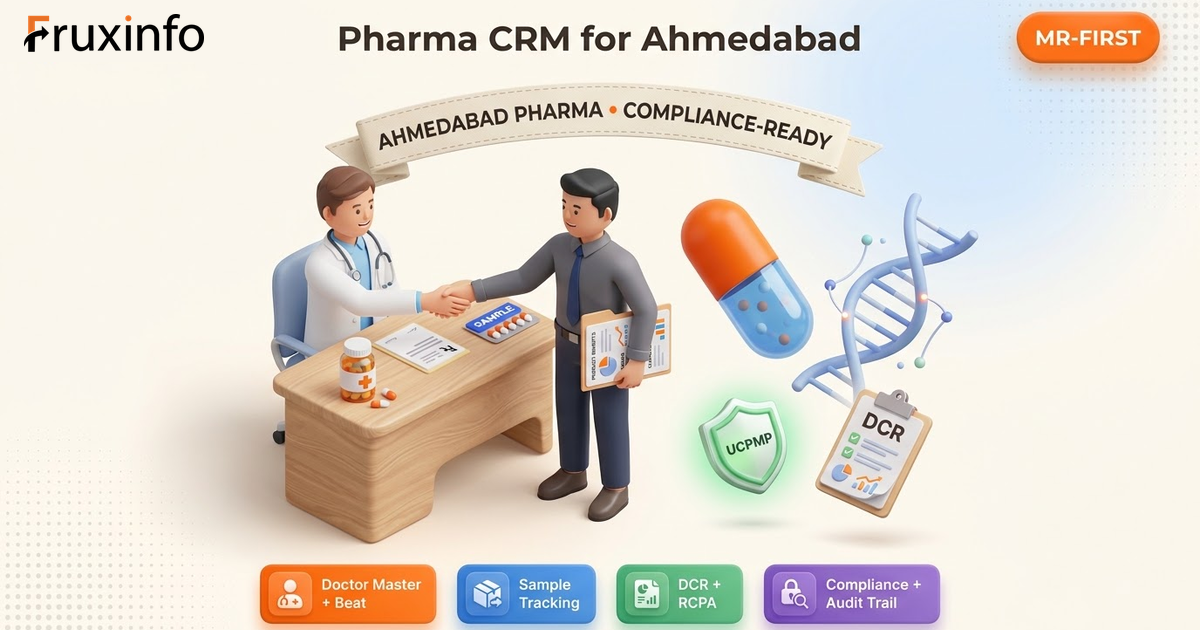
CRM for Pharma Companies in Ahmedabad: Compliance, Features, and Fit
23-07-2026
Pharma is not sales. Pharma is a regulated, documented, evidence-tracked, compliance-first business that looks like sales — MRs meet doctors, samples change hands, prescriptions get written, orders follow. But every step is auditable, every action leaves a trail, and getting the trail wrong has consequences that go beyond a bad quarter.
A generic sales CRM does not fit this world. It tracks deals; pharma needs to track doctor visits, sample distribution, prescription trends, sales-by-territory, MR productivity, and regulatory paperwork. All of it on a mobile device that a Medical Representative uses between chambers, in a car, in a parking lot outside a clinic.
This is a look at what a real pharma CRM looks like in 2026 for Ahmedabad companies — what it must do, what compliance requires, and what most off-the-shelf pharma CRMs get right and wrong.
Why pharma needs its own CRM
1. The "customer" is a doctor, not a buyer
Your MR meets a doctor. The doctor does not buy from you. The patient does, at a chemist, based on the doctor's prescription. Your CRM has to track influence — doctor visits, samples given, product education, prescription share — not deals.
2. Multi-tier hierarchy
MRs report to Area Business Managers, ABMs report to Regional Sales Managers, RSMs to Zonal Managers, up to the Head of Sales. Each tier needs its own view — MR sees their doctors, ABM sees their MRs' doctors, RSM sees the whole region. Off-the-shelf CRMs handle two levels well; pharma often needs four or five.
3. Territory and beat plan
An MR does not visit random doctors. They follow a beat — a planned circuit of doctors on specific days of the month. The CRM has to hold the beat plan, track visits vs plan, flag missed doctors, and let the manager approve deviations.
4. Sample management
Every sample is inventory going out. Regulation requires tracking who received it, when, and how many. Your CRM must log every sample given to every doctor, with proof (e.g., signature or acknowledgement).
5. Reporting cadence is intense
Daily Call Report (DCR) — every visit an MR makes has to be reported. Monthly reports on doctor coverage, sample distribution, product-mix, prescription share. Weekly reviews with ABMs. Auto-generation is essential; manual is a full-time job.
6. Compliance and audit trail
Marketing to doctors is a regulated activity. Every touchpoint, every gift, every sample must be logged, retained, and produceable on demand for internal audit or regulatory inspection.
What a pharma CRM must have
a. Doctor master with full profile
Every doctor with: name, qualification, specialty, hospital/clinic affiliation, MCI number, address, contact, preferred visit time, potential rating, prescription share, competitor products used. All of it on one screen.
b. Territory and beat plan
The MR sees their monthly beat — which day, which doctors, which chamber. Manager assigns and approves the beat. Missed visits auto-flag. Rearrangements need approval.
c. DCR (Daily Call Report) with photo/geo-tag
MR completes the visit, opens the CRM on their phone, logs the doctor visited, discussion points, samples given, products detailed, next-visit plan. Photo of the doctor's chamber or geo-tag optional but common (proves the visit happened).
d. Sample tracking
Product-wise stock with each MR, samples issued to which doctor, remaining balance. Auto-alert when MR crosses monthly quota. Return / expiry management.
e. RCPA (Retail Chemist Prescription Audit) capture
MRs collect prescription audit data from chemists — how many of the company's products vs competitors are being prescribed in the territory. Your CRM should let them enter this on their phone quickly and generate RCPA reports.
f. Doctor engagement scoring
Each doctor gets a score based on visit frequency, sample uptake, RCPA share, meeting quality. This helps the MR and manager prioritise which doctors to invest more time in.
g. Multi-tier reporting hierarchy
MR, ABM, RSM, ZM, National Sales Head — each with role-appropriate dashboards. ABM sees their MRs' coverage. RSM sees their ABMs' territories. National view rolls up everything.
h. Approval workflows
Beat plan changes, sample requisition, doctor category changes, expense claims — all through approval workflow with audit log.
i. Product master and detailing content
Each product with brand name, molecule, dosage, indication, contraindication, marketing collateral (visual aid, e-detail, video). MR pulls up product info on phone during doctor visit for reference.
j. Compliance-ready audit trail
Every action logged with user, timestamp, and change history. Retention policy configurable (typically 5 to 7 years for pharma). Exportable for internal audit.
k. Expense management
MRs travel. Fuel, food, doctor entertainment (within permitted limits), sample transport. Log expenses on the phone, manager approves, integrates with payroll.
l. Native mobile-first
MRs live on their phones. The CRM must work offline (chambers with poor network), sync when back online, be fast enough for a 90-second post-visit report.
What pharma CRM does NOT need (and vendors will demo)
- Marketing automation drip email — you do not email doctors like a B2B lead funnel
- Social selling — doctors are not on LinkedIn discussing pharmaceuticals
- Predictive AI on doctors — MRs know their territory better than any model
- Complex commission structures — most pharma comp is salary + incentives, not multi-attribution
- Deep customer-service module — pharma has a separate PV (pharmacovigilance) system for adverse events, not CRM tickets
Buy less. The compliance and reporting workload is heavy enough without adding features you will not use.
Compliance corner (Ahmedabad-specific)
Ahmedabad pharma CRMs typically need to be aware of:
- UCPMP (Uniform Code for Pharmaceutical Marketing Practices) — governs sample distribution, doctor gifts, sponsored events. Log every activity that falls under UCPMP.
- MCI / NMC guidelines — doctor interactions have to comply with medical council norms.
- Company internal SOPs — each pharma company has its own compliance layer on top of regulatory requirements.
- Data retention — typically 5 to 7 years for sales, sample, and visit data.
- Audit trail integrity — no user can delete history; changes are versioned.
Off-the-shelf pharma CRMs (Veeva, IQVIA, Salesforce Health Cloud) come with compliance features but are priced for large multinationals. Indian mid-size pharma companies (₹50 crore to ₹1000 crore revenue) often build custom to get the compliance layer without the multinational price tag.
Cost of a pharma CRM in Ahmedabad
| Scope | MR headcount | Typical range | Timeline |
|---|---|---|---|
| Small pharma (single-division) | 10–40 MRs | ₹4–10 lakh | 10–14 weeks |
| Mid-size pharma (multi-division) | 50–200 MRs | ₹10–25 lakh | 14–24 weeks |
| Large pharma (multi-region) | 200+ MRs | ₹25 lakh–₹1 crore | 6–12 months |
Compare to Veeva CRM (typical Rx pharma benchmark): USD 195/user/month = ~₹16k/user/month × 100 MRs = ₹1.9 crore/year, ₹9.5 crore over 5 years. Custom is a fraction, and it is built for your company's SOPs.
Custom vs ready-made for Ahmedabad pharma
Ready-made options:
- Veeva CRM — enterprise standard globally, expensive, deep compliance
- IQVIA OrchestraCX — similar tier
- Salesforce Health Cloud + AppExchange — flexible but requires heavy customisation
- MedRep, EasyPharma, RCPA-focused Indian tools — cheaper, weaker on compliance depth
Custom wins when:
- Your MR headcount is 30 to 200 (too small for Veeva pricing, too specific for cheap Indian tools)
- You have your own compliance SOPs beyond UCPMP baseline
- You want deep RCPA analytics that Indian tools skim over
- You want to own the data (not vendor-hosted)
- You have multi-division setups (Rx, OTC, generic, medical device) that off-the-shelf handles clumsily
How Fruxinfo builds pharma CRMs
Every pharma CRM we build starts with 2 to 3 days on the ground — walking the sales office, sitting with an MR on a beat visit, meeting the ABM, reviewing the current DCR forms, and reading the compliance SOP. Only then do we scope.
Every build includes: doctor master, beat plan, DCR with geo-tag, sample tracking, RCPA capture, multi-tier hierarchy, approval workflow, audit trail, offline mobile app, product master with detailing content, expense management, MR productivity dashboards, and configurable retention policy.
Timeline: 14 to 24 weeks for a mid-size Ahmedabad pharma company. Price: ₹10 to ₹25 lakh for the full build, fixed scope, fixed price. Post-launch, we usually stay on a maintenance retainer because compliance updates and reporting changes are constant in pharma.
If you are an Ahmedabad pharma company thinking about your CRM — tell us about your setup. We come back within two working days with a scope and price, tailored to your division structure and compliance layer.
Also read: CRM development in Ahmedabad and custom CRM development.
The bottom line
Pharma CRM is a compliance-first, MR-productivity-focused, doctor-influence-tracking system that looks nothing like a generic sales CRM. Get the fit right and your sales operation runs on rails — every visit tracked, every sample counted, every DCR filed on time, every audit passable.
Get it wrong — force pharma into a generic CRM or force a global pharma CRM into an Ahmedabad mid-size company — and the MRs will keep filing DCRs on paper and the company will keep running two systems.
Related Services
Want to put these ideas into practice? Talk to Fruxinfo Ahmedabad about: