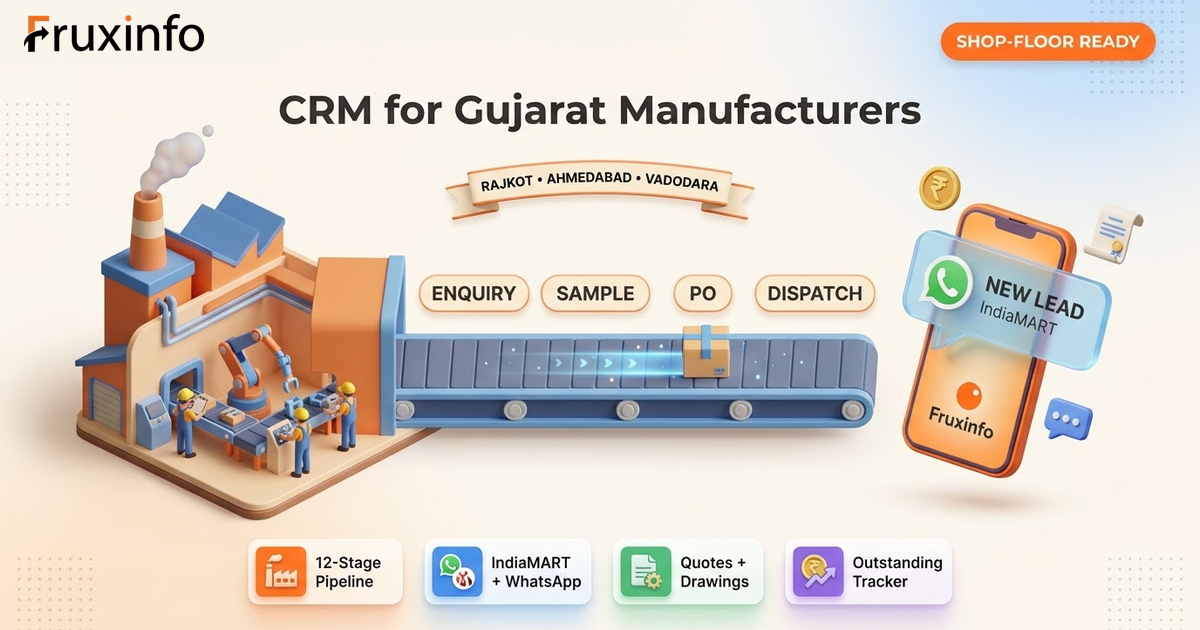
Best CRM for Manufacturing Businesses in Gujarat: What Actually Works
23-07-2026
Most CRM software is built for a company that sells software. It assumes an inside sales team, a clean lead-to-deal funnel, and a product you can demo over Zoom.
A manufacturing business in Gujarat looks nothing like that. Your leads come from IndiaMART, TradeIndia, exhibitions, factory visits, and old customers introducing new customers. Your "deal" starts as a Requirement For Quote (RFQ), turns into a technical drawing review, a sample approval, a PO, a production plan, a dispatch, and only closes months later when payment finally lands. And half your sales team is on the shop floor or a customer's factory site, not at a desk.
A CRM designed for tech sales will not fit. This guide walks through what a real manufacturing CRM in Gujarat actually needs — and what is safe to ignore no matter what the vendor demos say.
What makes manufacturing sales different
1. Long, technical sales cycles
A deal is not "quote sent → won → invoice." It is:
- Enquiry received
- Sample specification sent to customer
- Drawing / spec approval loop (often two or three revisions)
- Sample dispatch
- Sample feedback
- Commercial quote
- Negotiation
- PO received
- Production scheduling
- Manufacturing
- Quality check
- Dispatch
- Payment collection
Any CRM that shows a 4-stage funnel will not survive contact with this reality. You need a pipeline with 8 to 12 stages, all of which are meaningful — not decorative.
2. Product complexity per deal
A single enquiry might be for six SKUs, each with three variants and two grades. Or a single custom-fabricated item with drawings and material specs attached. A CRM that has one "product" field per deal will not do. You need line items, variants, drawings, and revision history — all attached to the same enquiry.
3. Multi-channel lead sources
Manufacturers in Gujarat typically pull leads from:
- IndiaMART (biggest source for most)
- TradeIndia
- Justdial
- Exhibitions (Vibrant Gujarat, Auto Expo, textile expos)
- Company website
- Direct WhatsApp enquiries
- Referrals
Each source has its own format, its own contact quality, its own conversion rate. Your CRM must capture the source cleanly on every lead — otherwise you cannot tell which channel is worth spending on.
4. Repeat customers, not one-off deals
Most manufacturing revenue is repeat business — the same customer buying the same items again next quarter. Your CRM needs to track a customer's lifetime value, not just the current deal. It should show at a glance: "Ram Industries: 34 orders in last 3 years, ₹1.2 crore lifetime, last order 22 days ago, payment cycle 45 days average."
5. Field team on the ground
Your sales team is at customer sites, on the shop floor, on the road. A CRM they can only open on a desktop is a CRM they will not use. Mobile access — real mobile, not a shrunken desktop — is non-negotiable.
What a manufacturing CRM must have
a. Multi-stage pipeline with sub-status
Enquiry → Spec review → Sample sent → Sample approval → Quote → Negotiation → PO → Production → Dispatch → Payment. Each stage should have sub-status so you can see, for example, that a deal is "in Sample Approval — waiting on customer feedback since 8 days" without having to open the record.
b. RFQ / quotation module
Line items, quantities, unit rates, taxes (GST breakdown), payment terms, delivery terms, PDF quote generation with your company letterhead, quote versioning. When a customer asks for a revised quote, the old one should stay in the record so you can see how negotiation moved.
c. IndiaMART lead sync
IndiaMART is a large lead source. Manually copying leads from your IndiaMART panel to your CRM every morning is where half of small manufacturers waste an hour a day. Your CRM should pull IndiaMART leads automatically via IndiaMART's API, assign them to the right salesperson based on rules, and notify them on WhatsApp within minutes.
d. Sample and drawing management
Every sample sent is inventory going out — track it. Every technical drawing shared with a customer is your IP — version it. Attach the current drawing to the deal so any team member can pick up where the last one left off.
e. Payment and outstanding tracking
Manufacturing runs on payment cycles. Your CRM should show, for every customer: total ordered, total invoiced, total paid, current outstanding, ageing bucket (0–30 days, 30–60, 60–90, 90+). Filter the whole customer list by "outstanding over 60 days" for the accounts team.
f. WhatsApp integration
Gujarat manufacturing runs on WhatsApp. Enquiries come in on WhatsApp. Drawings are shared on WhatsApp. Payment reminders go out on WhatsApp. Your CRM should let a salesperson send a WhatsApp message from inside the CRM (via WhatsApp Business API), and log the conversation on the customer record.
g. Mobile-first for field team
The salesperson at a customer's factory should be able to open the CRM on their phone, add a visit note, upload a photo of the sample the customer approved, and update the deal stage — all in under 30 seconds. If your CRM makes them wait for a page to load or asks them to log in three times, they will stop using it.
h. Reports the MD actually reads
The three reports every manufacturing MD in Gujarat wants at 9am:
- Yesterday's new enquiries by source, by salesperson.
- Deals stuck at "waiting for customer approval" for over 15 days.
- Outstanding payments over 60 days, sorted by amount.
If your CRM cannot produce these in a scheduled morning email, it is not doing its job.
What a manufacturing CRM does NOT need
Vendors will demo you dozens of features. Most of them do not matter for a manufacturing business. Skip these unless you know you specifically need them:
- Multi-currency handling — unless you export
- Complex commission structures — most Gujarat manufacturers have flat or step commission, not multi-tier attribution
- Marketing automation (drip sequences) — B2B manufacturing sales are relationship-driven, not email-drip driven
- Social media integration — LinkedIn matters occasionally; Facebook / Instagram lead-forms almost never
- AI-powered next-best-action — sounds great in a demo, adds noise in real operations
- Predictive scoring — the shop floor supervisor knows which enquiries are serious better than any model
Every feature you buy but do not use is complexity your team has to work around. Buy less. Use more.
Custom CRM vs Zoho vs Salesforce — for manufacturing
Same three options as every other CRM comparison, but the answer for manufacturing usually lands differently.
| Aspect | Salesforce | Zoho | Custom CRM |
|---|---|---|---|
| Multi-stage manufacturing pipeline | Yes (with configuration) | Yes (with limits) | Built for your exact stages |
| Line-item quotations with drawings | Available (add-on) | Basic | Yes, tailored to your product structure |
| IndiaMART sync | Manual or paid connector | Marketplace connector | Direct API integration |
| WhatsApp Business API | Third-party | Third-party | Native |
| Tally integration | Rare / expensive | Available (Zoho Books helps) | Yes, native |
| Cost for 20 users, 5 years | ₹1.6 crore+ | ₹30 lakh+ | ₹6–20 lakh one-time |
| Field mobile experience | Heavy | Decent | Built for your team's flow |
For most Gujarat manufacturers under 100 users, Zoho or custom. Salesforce enters the picture only if you are export-heavy, dealing with Fortune-500 buyers, or have a full-time CRM admin on payroll.
Rajkot, Ahmedabad, Vadodara — what we actually see
Fruxinfo has shipped CRMs into every major Gujarat manufacturing cluster. A quick read of what each cluster asks for:
Rajkot (auto components, engineering, casting)
Heavy focus on RFQ management, drawing versioning, and dispatch tracking. Rajkot manufacturers export more than the Gujarat average, so multi-currency and export documentation (packing list, commercial invoice, LC handling) come up often. Sample-approval cycles are long — track them.
Ahmedabad (chemicals, machinery, packaging, MSME)
Wide range. What everyone needs: IndiaMART lead capture, salesperson-wise pipeline visibility, and outstanding payment tracking. What some need: batch traceability if you are in chemicals or food, calibration reminders if you are in instrument manufacturing.
Vadodara (chemicals, pharma, engineering)
Compliance features matter more here — customer approval tracking, MSDS attachment, batch documentation, audit trail. Pharma clients also need complaint tracking with root-cause and CAPA closure.
Surat (textile, diamond, printing)
Textile order tracking (yarn-to-fabric-to-dispatch loop), broker commission handling, and heavy WhatsApp usage. Sample-catalog sharing is central — the CRM has to make it fast to send a customer 40 fabric samples with prices in one WhatsApp click.
How to pick right
Three-step process:
1. Write down your actual pipeline stages
On paper. Not what a textbook says. What actually happens between an enquiry landing and a payment clearing. Count the stages.
2. List the systems your CRM must talk to
Tally, IndiaMART, WhatsApp, courier tracking, factory scanner, your existing ERP, your payment gateway — write them all down. Every integration is a decision-point.
3. Score your team's tolerance for training
Is your sales team going to sit through a 4-hour Salesforce training? A 1-hour Zoho training? Or do they need a CRM that is intuitive enough for a first-day salesperson to figure out? Be honest — this is the single biggest predictor of adoption.
With those three pieces on paper, the choice usually makes itself.
How Fruxinfo builds manufacturing CRMs
We have shipped custom CRMs for auto-component manufacturers in Rajkot, chemical companies in Ahmedabad and Vadodara, textile mills in Surat, packaging companies, and pharma manufacturers. Every build starts with mapping the customer's existing pipeline on a whiteboard — every stage, every hand-off, every stuck point.
Then we build only what fits. IndiaMART sync, WhatsApp Business, Tally integration, quotation with GST breakdown, drawing versioning, outstanding-ageing reports — the modules that actually matter for a Gujarat manufacturer, delivered in 8 to 16 weeks, priced fixed.
If you are a manufacturer thinking about your first CRM, or unhappy with your current one, tell us about your process. We come back with a real scope and a real price, not a range.
You can also read about CRM development for Rajkot manufacturers, Ahmedabad businesses, or custom CRM development in general.
The bottom line
A manufacturing CRM is not just a sales CRM with an "industry" dropdown set to "manufacturing." The pipeline is longer, the products are more complex, the lead sources are different, the payment cycles are real, and the team is in the field. Buy or build the CRM that fits that reality — not the generic B2B-sales reality most CRM demos are built around.
Get the fit right and your team logs in every morning. Get it wrong and you spend the next three years watching them work around it in Excel.
Related Services
Want to put these ideas into practice? Talk to Fruxinfo Ahmedabad about: